
The record
Palestine before Israel
Ask whether Palestine was ever a state and you have already accepted the bar. Almost no people under Ottoman or European rule had a nation-state of their own — the same test erases Jordan, Lebanon, Syria, Iraq and most of Africa. It is asked about Palestine alone, and it is asked because the answer is meant to license what was taken. Below is the record instead: what existed, when, and who documented it.
c. 12,500 – 1,200 BC
Before the name
The people come before the word. Long before there is a name for this place in any archive, there are people living in it who were among the first anywhere to stop moving at all — and the line running from them through Canaan to the population of the land is carried by the archaeology and by the ancient DNA alike.
-
c. 12,500 – 9,500 BC
The Natufians stop moving
The Natufian culture of the southern Levant built some of the earliest sedentary communities known anywhere. They were settling in one place, with stone-built dwellings and cemeteries, before agriculture — which is the ordinary trigger for settling — had been invented.
What this establishes is that permanent habitation of this land is roughly fourteen thousand years old.
-
c. 9600 BC
Jericho builds a wall
Tell es-Sultan, at Jericho, was settled around 9600 BC and carries the oldest known town wall in the world. It is among the longest continuously inhabited places on earth, and people live there now.
-
c. 8000 BC
The dead are kept in the house
In the Pre-Pottery Neolithic, the people of Jericho and neighbouring sites buried their dead beneath the floors of their houses, and in some cases removed the skull, modelled the face back onto it in plaster and set shells in the eye sockets. Several of these plastered skulls survive, including one excavated at Jericho and now in the British Museum.
They are among the earliest portraits of human beings that exist, and they were made by people keeping their ancestors in the room with them.
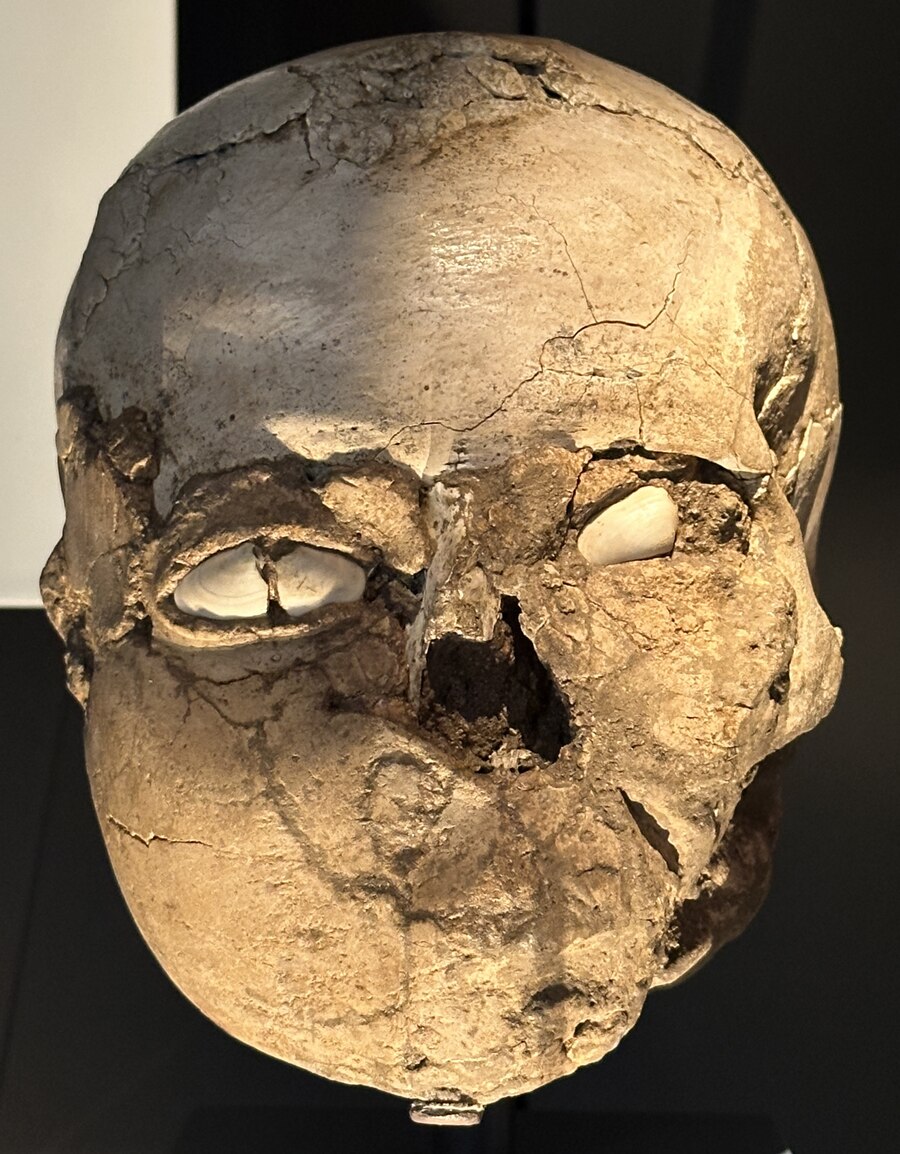
A plastered skull excavated at Jericho, now in the British Museum. The eyes are cowrie shells. It is around nine thousand years old, and it is somebody's face. -
c. 3500 – 1200 BC
Canaan
The Bronze Age brought Canaanite city-states — Jericho, Megiddo, Hazor, Lachish, Ashkelon, Gaza — with their own script, from which the alphabet this page is written in descends. Village settlement carried on continuously underneath every empire that passed over the top of it: Egyptian, Hittite, Assyrian, Babylonian, Persian.
-
The genetic record
What the ancient DNA shows
The people who live in Palestine descend from the people who were already living there.
Agranat-Tamir et al. (2020) sequenced 73 individuals from the Bronze Age southern Levant — the Canaanites — and compared them with populations living today. Palestinians were found to derive 81 to 87 per cent of their ancestry from them. Haber et al. (2017) reached the same conclusion from the other direction, sequencing Bronze Age Canaanites at Sidon and finding that present-day Levantines overlap them.
Those Bronze Age Canaanites descend in turn from the Neolithic farmers of this land, and they from the Natufians of the same hills, whose genomes Lazaridis et al. (2016) published. It is one line, in one place, and it has never been broken.
The 81 to 87 per cent figure is Bronze Age Levantine ancestry. The Natufian sits further back along the same line.
Haber et al. 2017, Canaanite and present-day Lebanese genomes (AJHG) · Agranat-Tamir et al. 2020, The Genomic History of the Bronze Age Southern Levant (Cell) · Almarri et al. 2021, The Genomic History of the Middle East (Cell) · Lazaridis et al. 2016, Genomic insights into the origin of farming in the ancient Near East (Nature)

c. 1180 BC – AD 135
The name, from Ramesses to Rome
One common Zionist claim is that Hadrian invented "Palestine" in AD 135 to erase Judea after the Bar Kokhba revolt, so the word is a punitive Roman coinage with nothing behind it. The root p-l-s-t is attested approximately thirteen hundred years before Hadrian, across at least four archives with no interest in one another's politics — including, a century before the revolt he was punishing, in the Greek of Jewish writers.
-
c. 1208 BC
Israel is first written down, as a people rather than a place
The earliest mention of Israel outside the Bible is Egyptian: the victory stele of Merneptah, which reads "Ashkelon is conquered, Gezer seized, Yanoam made nonexistent; Israel is wasted, bare of seed".
The interesting part is the grammar. Egyptian hieroglyphic writing tags a name with a silent determinative saying what kind of thing it is. Ashkelon, Gezer and Yanoam are tagged as city-states. Israel, in the same sentence, is tagged with the sign for a people — a group of human beings, not a territory.
So the oldest surviving use of the word describes a people. It becomes the name of a place later.
-
c. 1180 BC
Ramesses III has the Peleset carved into a temple wall
The earliest known attestation of the root is Egyptian. The Year 5 and Year 8 inscriptions of Ramesses III at Medinet Habu name the Peleset (prst) among a coalition Egypt fought, and show bound Peleset captives in relief. Papyrus Harris I records Ramesses settling captives "in strongholds bound in my name".
They came from somewhere else; exactly where is disputed. The traditional answer is the Aegean. Shirly Ben-Dor Evian, rereading the Egyptian records and the pottery, argues instead for displaced populations from Anatolia, Cilicia, Cyprus and Syria. The ancient DNA from Ashkelon shows newcomers whose extra ancestry is best matched by southern European populations — Bronze Age Crete, Sardinia or Iberia in the models — while the Anatolian and Levantine populations tested do not fit. Even in the earliest Philistine burials, most of the ancestry is local. None of this changes the point here, because the name did not belong to them and did not leave with them — it stayed on the land. Within a few centuries Assyria is using it for a region, the Hebrew Bible for a place, and Herodotus for the whole territory, coast and inland. The people were absorbed into the population already living there. The name became the country's.
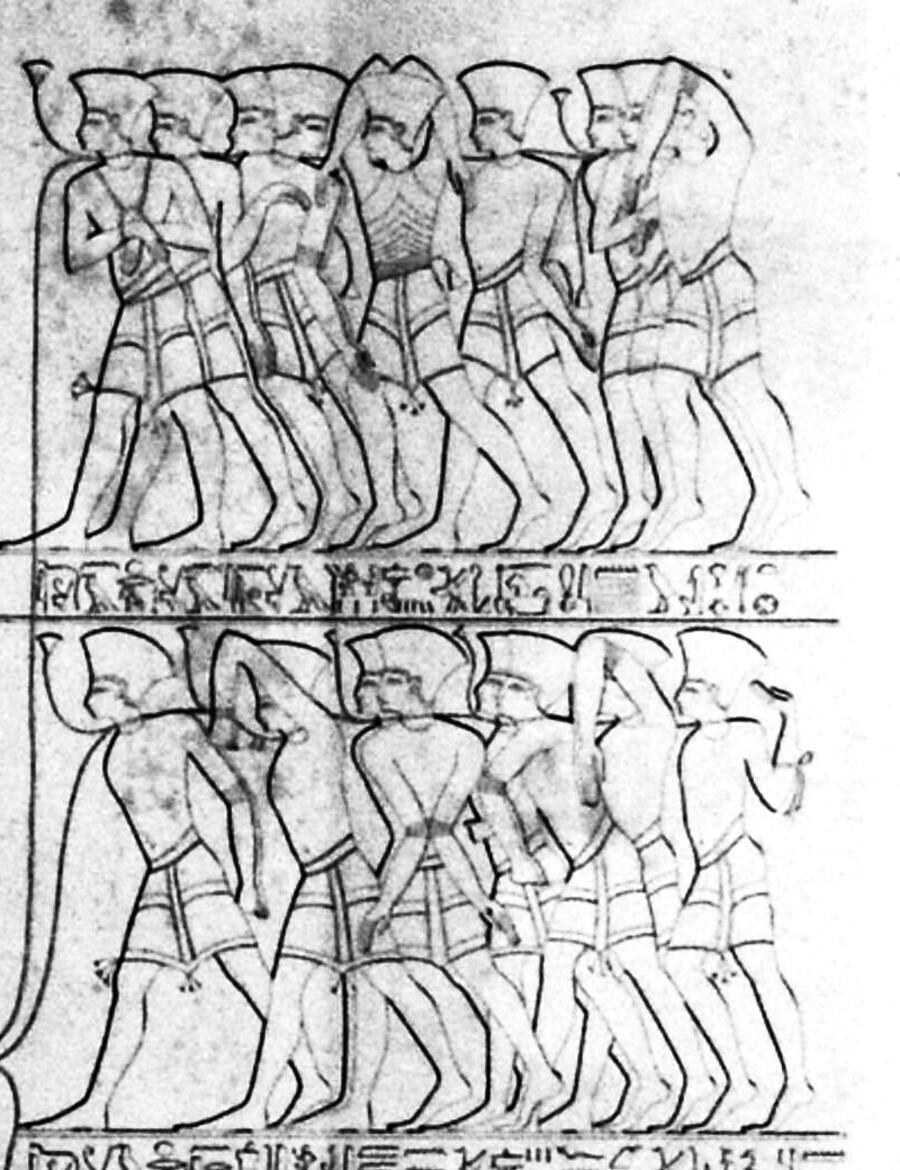
Peleset and other captives on the second pylon at Medinet Habu, drawn by Carl Richard Lepsius's Prussian expedition in the 1840s. The feathered headdresses in the upper register are the Peleset. This is a drawing of the relief, not a photograph of it - the expedition's epigraphic record is clearer than the weathered stone. Carl Richard Lepsius (1810-1884) · Public domain · source
Harris I says the captives were brought to Egypt and settled in strongholds. That Ramesses planted them specifically on the southern Levantine coast is a scholarly reconstruction rather than what the document says. Egypt settled war captives inside Egypt, far from their homelands, and other Egyptian texts place Philistine soldiers in Egypt's own army. Ussishkin, Finkelstein and Ben-Dor Evian date the Philistine settlement after Egyptian withdrawal altogether; Ben-Dor Evian puts it around 1150-1140 BC. The date of the inscriptions depends on the chronology used for Ramesses III's reign: Year 8 falls around 1180 BC on the conventional count and 1187 BC on Schneider's revised one.
Medinet Habu · Papyrus Harris I · Peleset · Ben-Dor Evian 2017, Ramesses III and the 'Sea-Peoples': Towards a New Philistine Paradigm (Oxford Journal of Archaeology) · Feldman et al. 2019, Ancient DNA and the genetic origins of early Iron Age Philistines (Science Advances)
-
c. 1150 – 604 BC
Gaza is one of the five Philistine cities
Gaza, Ashkelon, Ashdod, Ekron and Gath were the Philistine cities of the southern coast. They appear in the annals of Assyrian kings as places conquered, taxed and receipted — Gaza among them, under its own name, three thousand years ago.
The Ekron royal dedicatory inscription, found at Tel Miqne in 1996, names Ikausu son of Padi; both men appear independently as kings of Ekron in the annals of Sennacherib and Ashurbanipal. The city's own stone and a hostile empire's tax records agree.
The five cities are attested in the annals of Assyrian kings. The biblical lists in Joshua and 1 Samuel are Deuteronomistic, written more than five hundred years after the events they describe.
-
c. 930 - 586 BC
Israel and Judah are two kingdoms among the region's many
Two Israelite kingdoms formed in the highlands: Israel in the north, Judah in the south around Jerusalem. Judah gave its name to the territory it held — Yehudah, later Judea.
It was one polity among several sharing the same coastline and hills: Philistine cities on the coast, Phoenician ports to the north, Samaritans between, Nabataeans to the south, Canaanite populations throughout. Assyria destroyed the northern kingdom around 720 BC. Babylon destroyed Judah, Jerusalem and the Temple in 586 BC and deported part of its population.
Jewish presence in this land is ancient and real, and nothing on this page disputes it. It is not the weak point in the Zionist argument and pretending otherwise forfeits everything standing next to it.
-
9th – 7th c. BC
Assyria writes it down as a region
Palashtu, Pilistu, Palastu — the name appears in the tribute list of Adad-nirari III (r. 811-783 BC) and in the records of Tiglath-pileser III, Sargon II and Sennacherib. The Assyrians used it as a designation for the region, not only for a people.
-
7th – 5th c. BC
The name is in the Hebrew Bible, as a place
Pəlešet (פְּלֶשֶׁת) appears as a place name in Exodus 15:14, Isaiah 14:29 and 14:31, Psalms 60:8 and 83:7, and Joel 4:4. Worth stating plainly to anyone who says the word was invented to erase Jewish history: it is in the Tanakh.
The dating is the composition of these texts, which is contested and varies by book. The point does not rest on a precise date — only on the name being in the canon long before Rome.
Exodus 15:14; Isaiah 14:29, 31; Psalms 60:8, 83:7; Joel 4:4
-
written c. 7th - 5th c. BC
In Genesis, Israel is a man and Abraham is a stranger
The Hebrew Bible's own account starts the name with a person. Jacob wrestles through the night and is renamed: "Thy name shall be called no more Jacob, but Israel" (Genesis 32:28). Israel is a man. His descendants become the children of Israel, a family and then a people. Only later still is it a country on a map.
The same book is equally plain about Abraham. He is not a native of the land and does not claim to be: "And Abraham sojourned in the Philistines' land many days" (Genesis 21:34), and in his own words, "I am a stranger and a sojourner with you" (Genesis 23:4). Sojourner is the text's word for a resident alien — someone living in a country that is not his.
Genesis was written down long after the world it describes, and its Philistines are an anachronism: they do not arrive until around 1200 BC. That cuts both ways, and the way it cuts here is the sharper one — whoever wrote this, writing in the first millennium BC, called the territory the Philistines' land. The name is attached to the ground in Israel's own scripture.
Genesis 32:28, 21:34 and 23:4 (King James Version)
-
c. 604 BC
Ashkelon falls, and the Peleset stop being a separate people
Nebuchadnezzar destroyed Ashkelon, and the Philistines disappear from the record as a distinct group. Ancient DNA from the Ashkelon cemetery (Feldman et al., 2019) shows why: a European-related genetic component arrives around the time the Philistines do, and within a few centuries it can no longer be traced in the population at the same site. They were absorbed into the local Canaanite population, not replaced by it.
Palestinians are not descended from the Philistines; the DNA says otherwise. What the Peleset establish is the age of the name. The people are a separate case, made above.
Feldman et al. 2019, Ancient DNA and the genetic origins of early Iron Age Philistines (Science Advances) · Max Planck Institute summary of the Ashkelon findings
-
539 BC
Judea becomes a Persian province
Persia took Babylon, and the territory around Jerusalem became the province of Yehud — the name of the old kingdom, now an administrative unit of somebody else's empire. Exiles returned under Persian authority.
-
538 BC
The return from Babylon, and what becomes Judaism
Persia permitted the exiles to return and the Temple to be rebuilt. The religion that took shape in the Second Temple period — centred on Torah, on text and interpretation, and on one temple in one city — is the beginning of what would later be called Judaism. It was not yet that. The religion of the old kingdom of Judah had been a good deal less unified than what followed.
-
c. 440 BC
Herodotus calls the whole region Palaistine
In the Histories (1.105, 2.104, 3.5, 3.91, 7.89) Herodotus writes of "Syria called Palaistine", using it for the region broadly — coast and inland — and not merely for the Philistine cities. Six hundred years before Hadrian.
Herodotus, Histories 1.105 (Perseus Digital Library) · also Histories 2.104, 3.5, 3.91, 7.89
-
140 BC
The Hasmoneans win an independent kingdom
Alexander had taken Persia, and the Greeks called the territory Ioudaia. In the second century BC the Hasmonean revolt produced an independent Jewish kingdom, which lasted until Rome absorbed it.
-
AD 6
Rome makes it the province of Judaea
Rome ruled the territory through Herod and then annexed it directly, making it the province of Judaea in AD 6.
Follow the name across these entries and the pattern is plain. Judea was a kingdom, then a Persian province, then a Greek name, then an independent kingdom again, then a Roman province — and then Rome changed it to something else. Every empire that held this ground called it what suited the empire. That is equally true of Palestine. Neither name is a title deed.
Place names do not settle sovereignty three thousand years later. If they did, Constantinople would settle Istanbul.
-
c. AD 40 - 94
Jewish writers use the name, a century before Hadrian
Philo of Alexandria writes of "Palestinian Syria" in Every Good Man Is Free 75. Josephus uses the name in Antiquities 1.136 and 8.260 and in Against Apion 1.169.
This is the strongest single step in the sequence. Jewish historians were using the name for this land roughly a hundred years before the revolt Hadrian was supposedly punishing by inventing it.
Philo, Every Good Man Is Free 75 · Josephus, Antiquities 1.136 and 8.260; Against Apion 1.169
-
AD 70
Rome destroys the Second Temple
The revolt that began in AD 66 ended with Jerusalem taken and the Temple burned in AD 70. A religion built around one temple lost it, permanently.
-
c. AD 77
Roman geography uses it before Hadrian too
Pliny the Elder, Natural History 5.13-14: "Syriae quae Palaestina vocatur" — the Syria which is called Palestine. Aristotle, Ovid and Tibullus use the name as well.
-
AD 135
Hadrian renames the province, using a word already thirteen centuries old
After the Bar Kokhba revolt Rome renamed the province Syria Palaestina, and rebuilt Jerusalem as Aelia Capitolina. The renaming was very probably punitive and most historians read the package that way.
It almost certainly was. The point that follows is narrower, and it is unanswerable: Rome redeployed a name that had been in continuous use for over a millennium, including in Jewish writers' own Greek. Punitive reuse of an ancient regional name is not invention of a name.
Even if the name were a Roman coinage it would settle nothing. Germany, India and Greece are all exonyms of imperial origin, and so is "Jew", from Latin Iudaeus via Greek Ioudaios. No people's existence is adjudicated by the etymology of its label.
-
c. AD 200
The Mishnah is written down, and rabbinic Judaism begins
What replaced the Temple was text. The Mishnah was compiled around AD 200, the Talmuds over the centuries after it, and rabbinic Judaism — the ancestor of essentially every form practised today — grew out of that loss.
The order is the reason these entries are on the page. Abraham sojourns. Israel is a man. Judah is a kingdom. Judea is a province of four different empires in turn. And Judaism, as anyone would recognise it now, comes after all of it.
This is chronology and nothing more should be read into it. Every religion develops, every religion gets its name applied backwards over its own beginnings, and none of that makes any of them less real or less anyone's.

1862 – 1918
Before the Mandate
Two stories run through these years and they are told here in one sequence, in date order, because that is how they happened. One is a country with an administration, a survey naming nine thousand of its places, and a press addressing its readers as Palestinians. The other is a movement forming in Europe, arriving, buying, and being promised the place by an empire that did not hold it. Palestinian national identity did not begin with Zionism and it did not begin with Britain — read the dates and you can see that for yourself.
-
1862
Zionism takes root, in Germany
Moses Hess published Rome and Jerusalem in Germany in 1862, arguing for a Jewish national revival in Palestine. Twenty years later Leon Pinsker published Auto-Emancipation in Odessa, written in the aftermath of the pogroms that swept the Russian Empire from 1881 and the May Laws of 1882. Hovevei Zion formed in Eastern Europe in the same years.
The movement began in Europe, among Europeans, about a country none of them lived in.
The conditions these men were writing about were real. The pogroms happened, the May Laws happened, and European antisemitism killed people and drove them out. Nothing on this page disputes that, and the argument here is not about why they wanted somewhere to go. It is about the place they chose being somebody else's.
When people call Zionism a white colonial project, this is what they are pointing at. Not the complexion of anybody living in Israel now — the origin of the project. It was thought up in Germany and Odessa, written in Vienna, founded at a congress in Switzerland, financed from Paris, and carried out under the protection of the British Empire. The usual reply is that most Jewish Israelis today are not of European descent. That is an answer to a claim nobody made. Who arrived decades later, and under what pressures, says nothing about who began a colonial project or where they began it.
-
1871 – 1877
A British survey maps and names over nine thousand places
The Palestine Exploration Fund carried out the Survey of Western Palestine, mapping the country at one inch to the mile and recording the names of more than nine thousand sites. It remains a standard reference for the pre-1948 landscape, and it was compiled by British officers, not by Palestinians.
A survey records what a surveyor found. It is cited here because the claim it answers — that the land was empty, or that its people arrived later, drawn by Jewish development — is a claim about the 1870s onward, and this is the British Empire's own contemporaneous record of who and what was already there.
-
1872
Jerusalem is made a district answering directly to Istanbul
The Ottoman government established the Mutasarrifate of Jerusalem, an autonomous sanjak reporting straight to Istanbul rather than through a provincial capital. The sanjaks of Nablus and Acre sat under the Beirut vilayet. Ottoman census, land (tapu) and tax registers record the villages of the district by name — including hundreds later destroyed.
This was Ottoman administration, not Palestinian self-rule. What it shows is that the territory was treated as a distinct unit worth administering separately, and that its population was counted, taxed and written down.
-
6 July 1882
Zionism arrives in Palestine
Fourteen members of Bilu landed at Jaffa on 6 July 1882, and the First Aliyah had begun. Rishon LeZion was founded on 31 July; Zikhron Ya'akov and Rosh Pinna followed before the year was out. Around twenty-five thousand people came over the next two decades, mostly from the Russian Empire and Romania.
This is the date the movement stops being an argument in European pamphlets and becomes settlement on the ground.
-
from 1883
Edmond de Rothschild pays for the colonies
The first settlements were failing. From 1883 Edmond James de Rothschild of the Paris branch rescued and then ran them — Rishon LeZion, Zikhron Ya'akov, Rosh Pinna, Mazkeret Batya, and support to Petah Tikva. He was known as HaNadiv HaYadua, the Well-Known Benefactor. His salaried administrators governed the colonies so tightly that the settlers repeatedly revolted against them. The holdings passed to the Jewish Colonisation Association in 1899 and then to PICA, which became one of the largest landowners in Palestine.
Two precisions, and they matter. Edmond de Rothschild was not a political Zionist: he rebuffed Herzl when they met in 1896 and was hostile to the movement for years afterward. And none of this was secret — it is in the family archive, the colony accounts and the land registries, which is exactly why it is usable. Told as a hidden hand directing events it becomes the oldest antisemitic conspiracy story there is, and trades a documented case for one that can be dismissed in a sentence.
-
12 June 1895
Herzl writes down what to do about the people already there
From his diary: "We shall try to spirit the penniless population across the border by procuring employment for it in the transit countries, while denying it any employment in our country."
In June 1895 Herzl had not settled on Palestine — Der Judenstaat, a year later, still weighed Argentina — so "our country" in that entry is not necessarily this one, and that is the standard reply to it. What the entry shows regardless is the movement's founder, at its outset, working out how to remove an existing population from wherever the territory turned out to be, and recording the method in writing.
Herzl, Complete Diaries, 12 June 1895
-
1896
Herzl publishes Der Judenstaat in Vienna
Theodor Herzl was born in Budapest in 1860 and worked as a journalist in Vienna. Covering the Dreyfus Affair in Paris in 1894 convinced him that assimilation had failed. Der Judenstaat followed in 1896, in Vienna.
-
29 - 31 August 1897
The First Zionist Congress meets in Basel
Two hundred delegates met in Switzerland and founded the movement. Herzl wrote in his diary: "At Basel I founded the Jewish State."
It is worth sitting with the geography. The founding act of the movement took place in a Swiss city, among Europeans, concerning a country none of them lived in and most had never seen.
-
1899 - 1908
The movement names its own institutions
The Jewish Colonial Trust was founded in 1899 as the movement's bank. The Palestine Land Development Company followed in 1908 to buy and prepare land for settlement.
Nobody has to characterise this from outside. Colonial and Land Development are the words the movement chose for itself, at the time, on its own letterhead.
-
1903
The territory was chosen, and the choice was nearly made elsewhere
Herzl weighed Argentina in Der Judenstaat itself. He pursued El Arish, in Sinai, in 1902 and 1903. Britain then offered Uganda, and at the Sixth Zionist Congress in 1903 the movement voted to send a commission to investigate it.
This is the answer to the claim that the attachment was primordial and inseparable. A claim that might have been satisfied in East Africa is a movement selecting a site, not a people returning to the only place it could have gone.
The Uganda proposal split the movement and was rejected in 1905, and its opponents argued precisely from attachment to Palestine. That the argument had to be had at all is the point: it was a question with more than one possible answer.
-
1908
Al-Karmil begins publishing in Haifa
Najib Nassar founded al-Karmil, which made the sale of land to Zionist buyers its running subject. It was publishing that argument nine years before the Balfour Declaration.
-
1911
Filastin begins publishing in Jaffa, and calls its readers Palestinians
Issa El-Issa founded Filastin (فلسطين) in Jaffa with his cousin Yousef.
It addressed its readers as Palestinians. That is the thing to take from this entry. A mass-circulation newspaper was speaking to its readership as a Palestinian public, in print, from 1911 — six years before the Balfour Declaration, eleven before the Mandate, and thirty-seven before the Nakba. Nobody had to be told who they were.
It became the most influential paper of the late Ottoman and Mandate period, and it warned about Zionist land purchase years before Balfour. It was suspended repeatedly, first by the Ottoman authorities and then by the British. A paper worth censoring twice, by two empires, is a paper with a constituency.
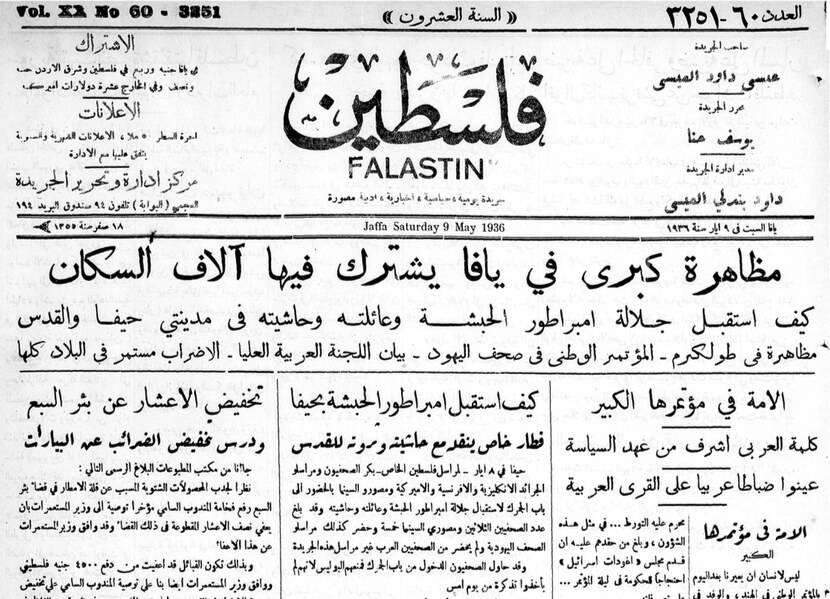
Filastin for Saturday 9 May 1936, printed in Jaffa - volume twenty, issue 3,251. Issa Daoud El-Issa, who founded it in 1911, is still named at the top of the page. Filastin · CC BY-SA 4.0 · source
Filastin · Rashid Khalidi, Palestinian Identity (1997)
-
by 1914
Roughly three dozen Arabic papers and periodicals are in circulation
Al-Karmil and Filastin were the two that mattered most, but they were not alone: approximately thirty-six Arabic newspapers and periodicals were circulating in Palestine before the First World War.
Cited as an order of magnitude. Counts differ between sources depending on what is counted as a periodical and over what span.
Rashid Khalidi, Palestinian Identity (1997)
-
July 1915 - March 1916
Britain promises the land to the Arabs
Ten letters passed between Sharif Hussein bin Ali of Mecca and Sir Henry McMahon, Britain's High Commissioner in Egypt. The offer was Arab independence across the Ottoman Arab provinces, in exchange for rising against the Ottomans. The Arab Revolt began in June 1916, with a British liaison officer named T. E. Lawrence among those urging it on.
Britain later said McMahon's letter of 24 October 1915 had excluded Palestine, through a clause reserving "portions of Syria lying to the west of the districts of Damascus, Homs, Hama and Aleppo". That reading does not survive a map. All four cities lie far to the north, and Palestine is south of Damascus, not west of it. The exclusion was constructed afterwards, to be needed later.
-
May 1916
The same land is quietly divided with France
While the correspondence with Hussein was still running, Britain and France agreed in secret to partition the same territory between themselves. The Sykes-Picot agreement stayed secret until the Bolsheviks found the Tsarist copies in the imperial archives and published them — in November 1917, weeks after Balfour.
Lawrence knew about Sykes-Picot while he was still urging the revolt forward. He wrote about his own part in it afterwards, in Seven Pillars of Wisdom.
-
2 November 1917
Balfour promises it to a third party, in sixty-seven words
The Foreign Secretary, Arthur Balfour, wrote to Walter Rothschild, 2nd Baron Rothschild, for onward conveyance to the Zionist Federation. His Majesty's Government, the letter said, "view with favour the establishment in Palestine of a national home for the Jewish people".
Read what it does with the people already there. It undertakes that "nothing shall be done which may prejudice the civil and religious rights of existing non-Jewish communities in Palestine" — civil and religious rights only, not political or national ones. Roughly nine in ten of the population of the country, and they appear in the document that disposes of their country as the non-Jewish communities. Not by name. Not as Palestinians. Defined by what they were not.
No Palestinian was asked, before or after.
Balfour was a British Cabinet decision serving British imperial interests — securing the approaches to Suez, and wartime calculations about opinion in Russia and the United States. It was not a favour granted to anyone; it was an empire disposing of a country it did not yet hold.
The Balfour Declaration, full text (Avalon Project, Yale Law School) · Balfour Declaration

1920 – 1948
Under the Mandate
Then came everything a country ordinarily has: a citizenship, passports carried by hundreds of thousands, a currency that was legal tender, an export economy that was most of the region's trade, a broadcaster and a football team on FIFA's register. None of it was granted by a Palestinian state, because there was not one — foreign powers never allowed a full state to be created. And that is the point. Every item below was administered, taxed, registered and filed, and every one of them was checkable at the time by anyone who cared to look.
-
1921 - 1925
The Sursock purchases, and the tenants are put off the land
Large tracts were bought from absentee landlords, most notoriously from the Beirut-based Sursock family, who sold much of Marj Ibn Amir — the Jezreel Valley. The fellahin who had farmed it for generations were tenants rather than registered owners, and were evicted in the thousands.
Legal title on paper; dispossession on the ground. Both of the Mandate's own inquiries into the disturbances, Shaw and Hope Simpson, documented it in 1930.
The Sursock Purchases · The Hope Simpson Enquiry, 1930 · The Shaw Commission, 1930
-
4 November 1923
Jabotinsky writes the Iron Wall
Ze'ev Jabotinsky, a founding figure of the movement's dominant strand, published The Iron Wall in the Russian-language paper Rassvyet.
"Zionist colonization, even the most restricted, must either be terminated or carried out in defiance of the will of the native population."
"This colonization can, therefore, continue and develop only under the protection of a force independent of the local population — an iron wall which the native population cannot break through."
This is the single strongest source on the page. He is not a critic of Zionism, he is one of its architects, he is describing colonization and the displacement of a native population approvingly, and he cannot be waved away as a hostile witness. The wording above is the English translation published in the Jewish Herald, South Africa, in 1937. Looser paraphrases of it circulate.
Jabotinsky, The Iron Wall, Rassvyet, 4 November 1923 · Iron Wall (essay)
-
1925
Palestinian citizenship is created, and people carry it
The Palestinian Citizenship Order created the legal status of Palestinian citizen. Mandate passports identified their holders as Palestinian, and hundreds of thousands of people held them. Refugees still keep them.
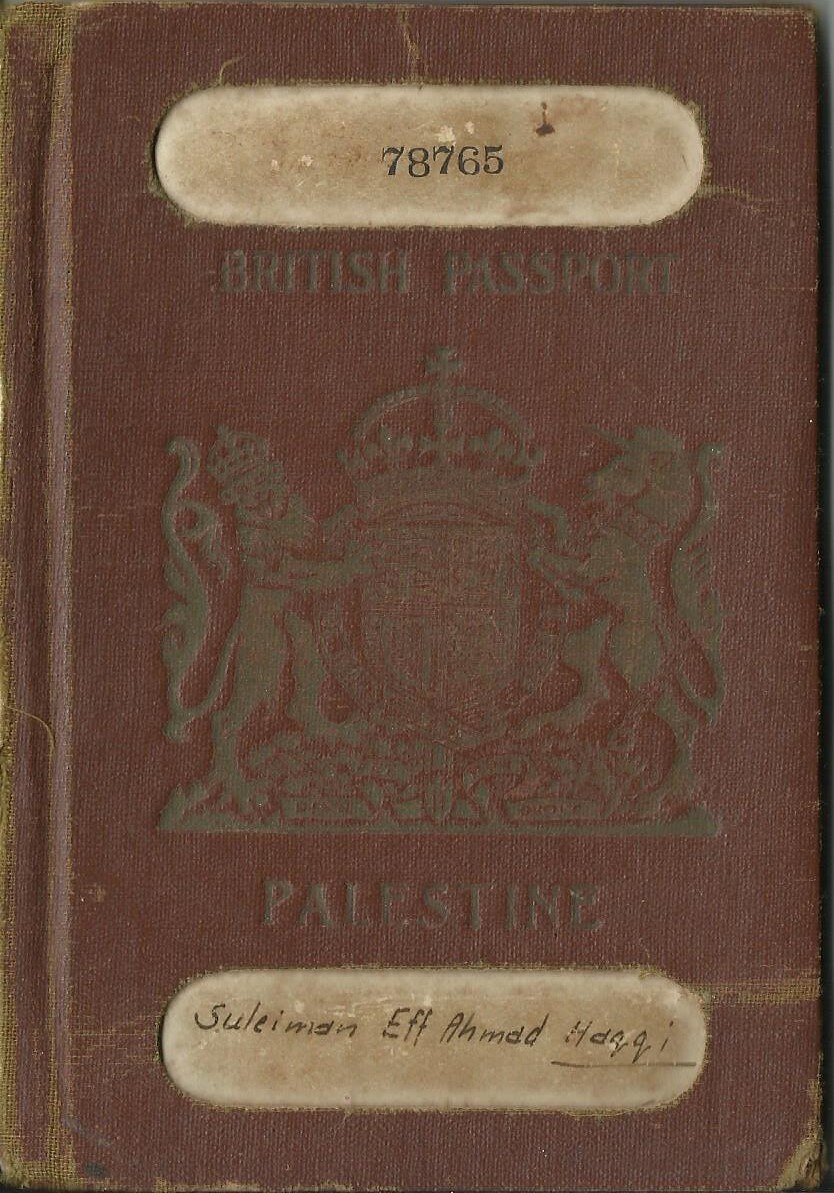
A Mandate passport. BRITISH PASSPORT at the top, PALESTINE at the foot, and the holder written in by hand: Suleiman Eff. Ahmad Haqqi. Wikimedia Commons user Mokordi · CC BY-SA 4.0 · source
The order was a British instrument, not the act of a Palestinian government. What it establishes is that "Palestinian" was an administered legal nationality with documents attached — and that the people who held it were stripped of it in 1948 rather than never having had it.
-
1927 – 1948
The Palestine pound is legal tender
The Palestine Currency Board issued the Palestine pound, printed trilingually — Arabic فلسطين, English Palestine, Hebrew. It was the legal tender of the country until 1948.
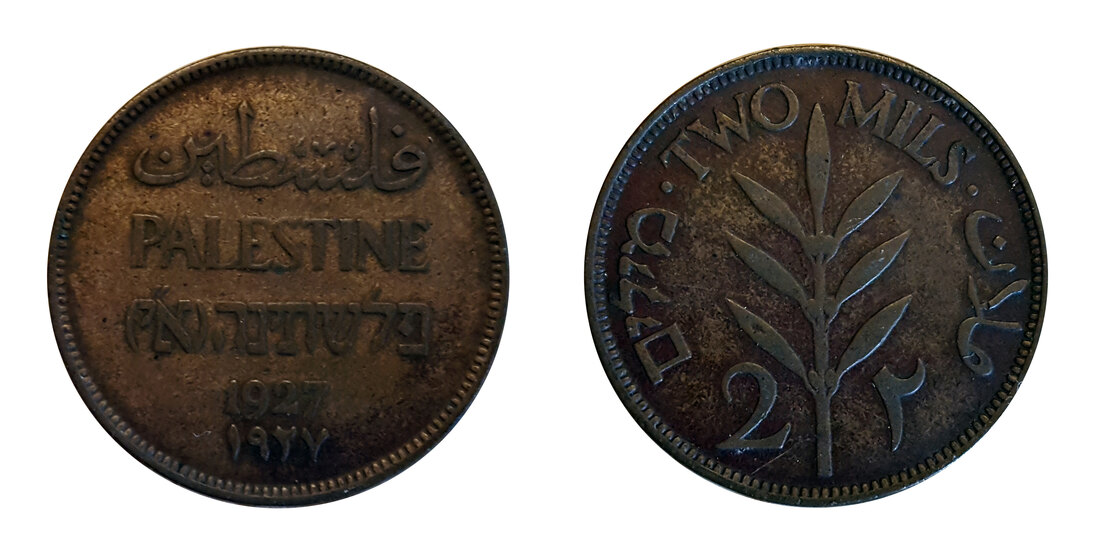
Two mils, 1927. The country's name struck into the metal in three scripts. A Franzen · Public domain · source
Issued by a British-appointed board, like the citizenship a year or two earlier. A currency is still a currency: it circulated, it was accepted, and the name on it was Palestine.
-
1927 – 1939
Palestine exports, and citrus is most of it
The country ran a substantial export economy, and the Shamouti orange shipped worldwide as the Jaffa orange was the bulk of it. Citrus was around 43 per cent of export value in 1927 and the clear majority of it by the late 1930s. By 1939 Palestine was shipping on the order of fifteen million cases a year.
The trade was regulated and registered. More than a hundred trade marks for oranges were entered during the Mandate, by Arab and Jewish growers and shippers alike, most of them built on the geographical name.
The share of export value varies between sources — figures from roughly 60 to over 80 per cent circulate for the late 1930s, depending on the year and on whether value or volume is measured. What is not in dispute is the direction. The industry was also shared: Arab and Jewish growers both built it.
Jaffa orange · Birnhack, The Emergence of a Brand: Jaffa Oranges from Mandate Palestine · Institute for Palestine Studies, The Land of Rebellious Oranges
-
1934 and 1938
Palestine plays World Cup qualifiers under its own name
A team entered FIFA's World Cup qualifying competition as Palestine, in 1934 and again in 1938. The name on the international register was the name of the country.
The squad was drawn largely from Jewish clubs and run by a Zionist-led association, so this is not evidence of Arab Palestinian national representation. What it evidences is the standing of the territory and its name: FIFA had Palestine on the books as the country these players represented.
-
1936
The Palestine Broadcasting Service goes on air
A national broadcaster, transmitting in Arabic, English and Hebrew. Alongside it by this point: Palestine postage stamps, courts, municipalities, chambers of commerce and schools.
-
1936 – 1941
Palestine is on the globe in American living rooms
A Cram lighted globe of this period, of the sort sold as furniture across the United States, letters PALESTINE in the same bold capitals as SYRIA, TURKEY and LEBANON, with Transjordan lettered separately across the river and Jerusalem and Haifa marked as cities. Nobody involved in printing it held a position on any of this.
That is what makes it worth citing. The erasure is recent enough that it can be dated against a mass-market consumer product: within living memory, Palestine was simply on the globe, and no American buying a lamp for the study thought the label was controversial.
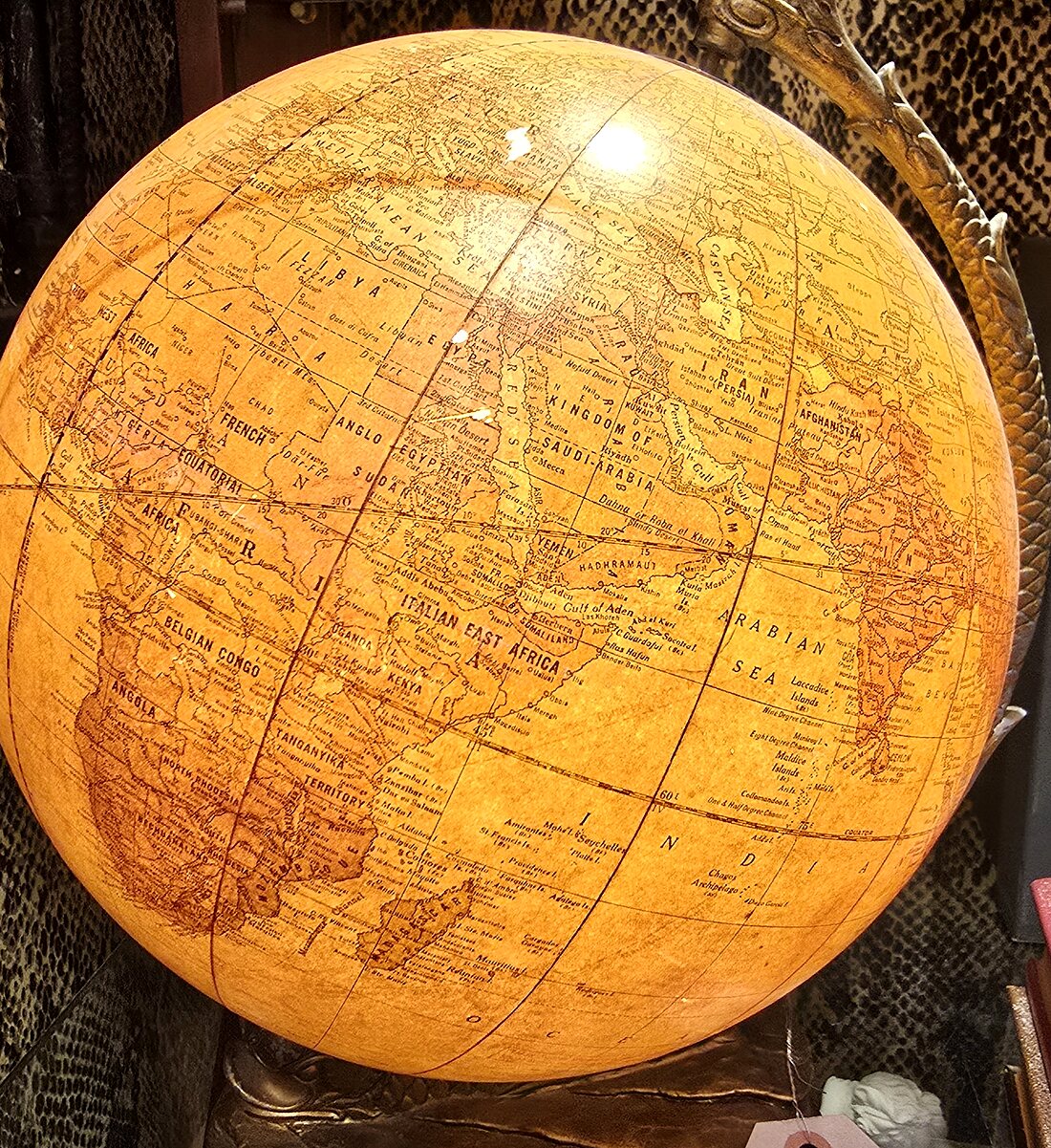
The object: a Cram lighted globe, sold as household furniture. ITALIAN EAST AFRICA, across the Horn, is what dates it — that entity existed only between 1936 and 1941. 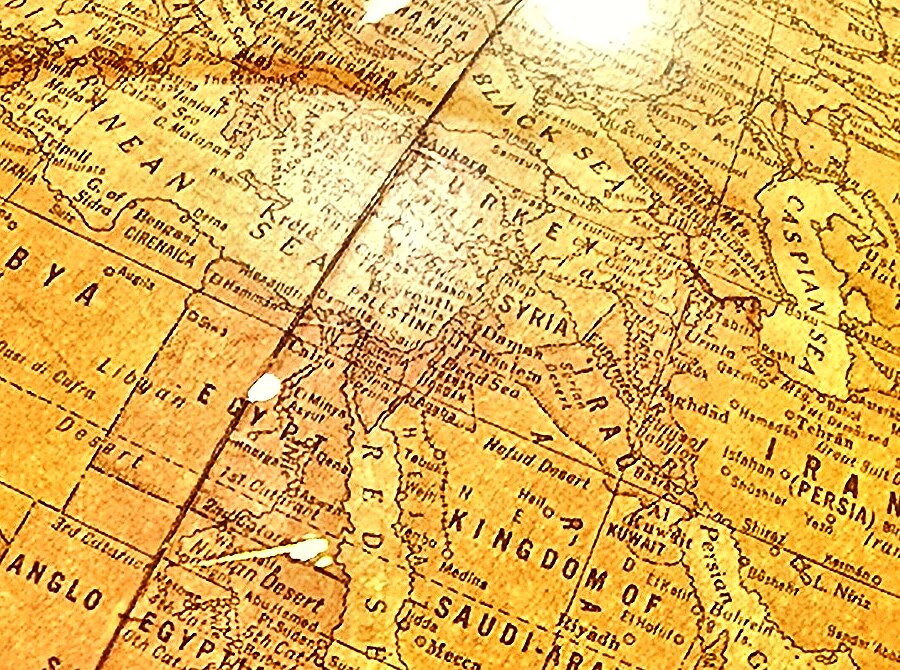
The label: PALESTINE, set in the same capitals as SYRIA and TURKEY. A country among countries, on a lamp in somebody's study. Any atlas or globe of the period shows the same thing, which is how a reader can check this without taking our word for it. The date range is fixed by the globe itself rather than by its price tag: it letters Italian East Africa, which existed only from 1936 to 1941.


1947 - today
What was taken
Everything above is the answer to "was there ever anything there". This is what happened to it. Every figure below is checkable and the sources are on each entry, because this is the part a reader is most likely to have been told is exaggerated.
-
1945
Who owned the land, by the Mandate's own count
Two years before partition the British administration counted land ownership across Palestine, sub-district by sub-district, and published it in the Village Statistics. The United Nations mapped the result for the committee that drew up the partition plan.
It divides every sub-district three ways — Arab, Jewish, and public and other — rather than two, which is why it is worth looking at closely. Ramallah was 99 per cent Arab-owned. Hebron 96. Jenin and Jerusalem 84. Gaza 75. Tulkarm 78. Nablus 87. Jewish ownership passed a third in only three sub-districts in the whole country: Jaffa, Tiberias and Haifa.
Across all of Palestine, Jewish ownership came to roughly six to seven per cent of the land. That is the number the partition entry below rests on, and this is where it comes from.
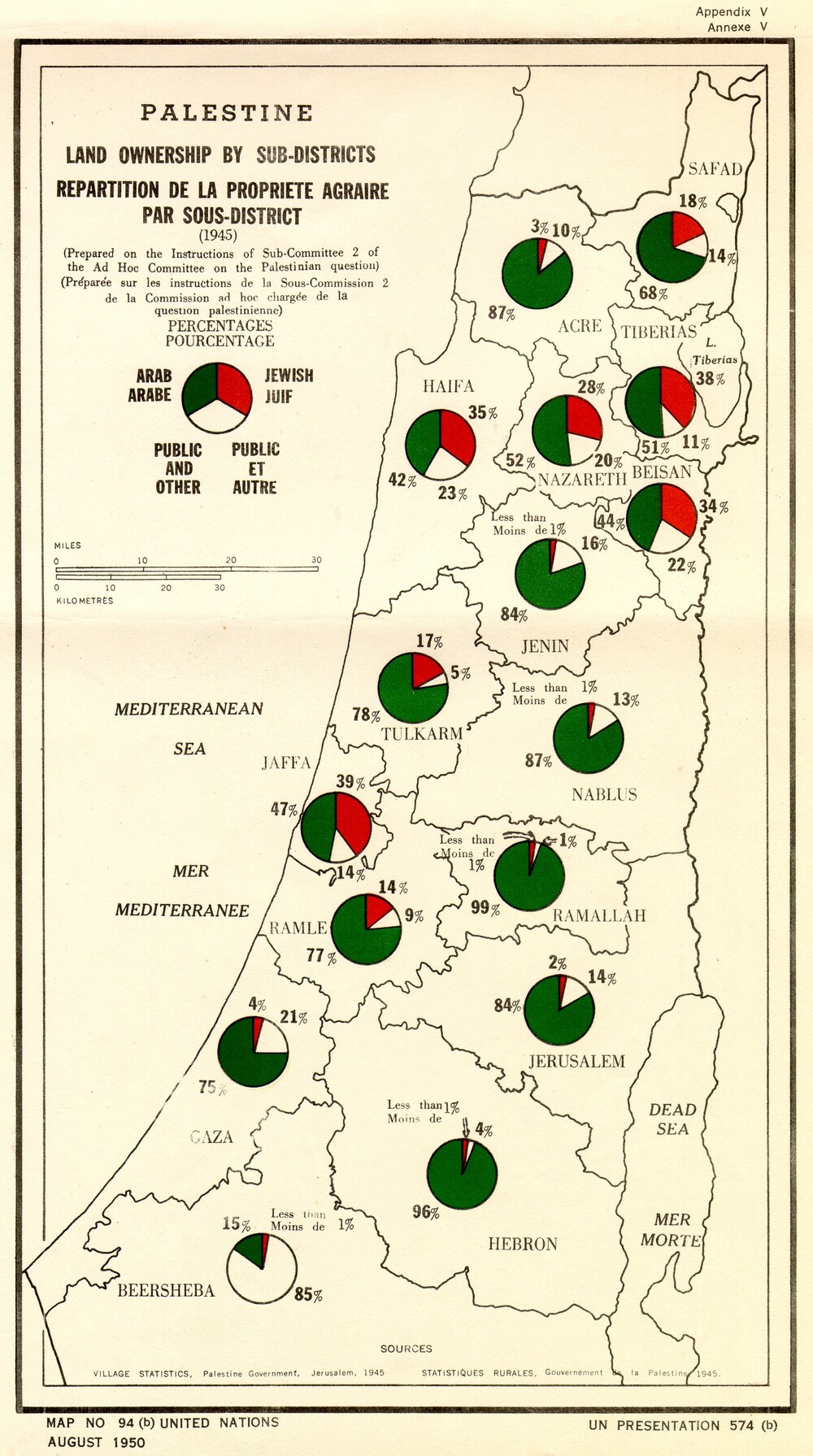
UN Map No. 94(b), August 1950, prepared for the committee that drew the partition plan and taken from the British administration's Village Statistics of 1945. Green is Arab ownership, red Jewish, white public and other. United Nations · Public domain · source
Beersheba — the Negev, and nearly half the territory — is 85 per cent "public and other", and that is the honest complication. It is also the answer to the usual objection that maps of this shade the Negev as Palestinian: here it is shaded as neither, out of the British administration's own figures, and Jewish ownership there is still under one per cent.
-
29 November 1947
The UN recommends partition, and three numbers tell you what it was
General Assembly Resolution 181 allotted roughly 56 per cent of the territory to a Jewish state. That population was about a third of the total, and it held roughly 6 to 7 per cent of the land.
Those three numbers are the whole argument, and they should be said together. It was a recommendation of the General Assembly, non-binding, drafted without a vote by the people who lived there.
The Arab rejection of the plan is usually offered as the thing that settles everything. Declining a proposal is not a crime, no other people on earth is held to have forfeited its homeland by refusing to partition it, and nothing was owed.
-
25 December 1947 - 14 May 1948
Two hundred towns and villages were emptied before any Arab army crossed a border
This is the part of the sequence that is usually left out, so here are names and dates.
al-Mas'udiyya, outside Jaffa, was the first, on 25 December 1947. Lifta, on the edge of Jerusalem, followed on 1 January 1948; nearly three thousand people lived there, and its stone houses are still standing empty above the road into West Jerusalem. Wadi al-Hawarith in Tulkarm, 2,552 people, on 15 March. Al-Shaykh Muwannis, 2,239 people, on 30 March — Tel Aviv University was later built on its land. Deir Yassin on 9 April, where the Irgun and Lehi killed around a hundred villagers. Ayn al-Zaytun on 2 May, another massacre.
Then the cities. Tiberias on 18 April. Haifa on 21 April, seventy-two thousand people. Jaffa on 26 April, seventy-six thousand. Safad on 11 May, Beisan on 12 May.
Israel declared independence on 14 May 1948. The Arab states entered on the 15th. Everything above had already happened.
Two hundred is the count of places in the standard depopulation table with a recorded date before 15 May 1948, and the dates and populations here are read from it rather than remembered. The populations are the 1945 village statistics, the last full count taken.
List of towns and villages depopulated in the 1948 Palestine war · Walid Khalidi, All That Remains (1992), the village-by-village record · Lifta · Deir Yassin massacre
-
1948
The Nakba
More than 750,000 Palestinians were expelled or fled. Around four hundred towns and villages were depopulated, and by mid-1949 most of those sites were wholly or partly in ruins. Almost none of the people were permitted to return, and the Absentees' Property Law of 1950 transferred what they had left behind.
By the time the Arab states entered on 15 May, roughly 250,000 to 300,000 people had already been driven out — the entry above is the list. Plan Dalet, the operational plan under which much of it was carried out, dates from March 1948.
The Israeli historian Benny Morris documented these expulsions out of the state's own military archives, and remains politically unapologetic about them. He is cited here in preference to more sympathetic historians for that reason: he cannot be dismissed as a partisan.
Benny Morris, The Birth of the Palestinian Refugee Problem Revisited (2004) · 1948 Palestinian expulsion and flight
-
1967 - today
And since
Israel took the West Bank, Gaza, East Jerusalem, Sinai and the Golan in June 1967. Around 700,000 settlers now live in the occupied West Bank and East Jerusalem, which Article 49(6) of the Fourth Geneva Convention forbids.
On 19 July 2024 the International Court of Justice found the occupation unlawful and said it should end. In September 2025 the UN Independent International Commission of Inquiry found Israel responsible for genocide in Gaza.
The map below is the short version: the same coastline, four times, over fifty-four years.
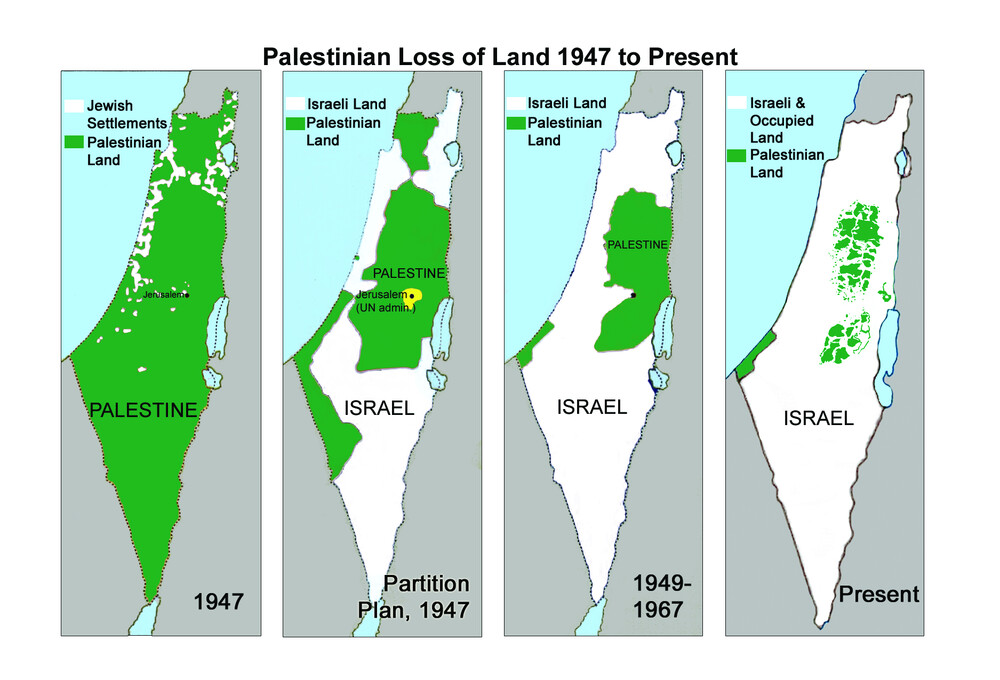
Palestinian Loss of Land, 1947 to the present. The card was created by the Palestine-Israel Action Group at Ann Arbor Friends Meeting. Anne and Fred Remley produced and distributed it for years — more than half a million cards, sent on request to people running demonstrations. Anne moved to Boulder in 2019 and stood at Canyon and Broadway on Saturdays until shortly before her death in November 2025, aged 95. Palestine-Israel Action Group, Ann Arbor Friends Meeting · source
One note on reading it. "Palestinian land" on that map means the land the native Palestinian population lived on, farmed and held rights over. It does not mean land held by a Palestinian state, because as everything above shows, no Palestinian state was ever permitted to exist.
The usual objection is that much of the green was Ottoman and then British state land rather than private freehold. That is true of the legal category and it changes nothing that matters. Under Ottoman miri tenure the cultivator's rights were real and heritable, and the people holding them were Palestinians. It is a map of who was there, not a register of deeds.
ICJ advisory opinion, 19 July 2024 · UN Commission of Inquiry finds genocide in Gaza, September 2025 · Ottoman Land Code of 1858, on miri tenure
-
June 2007 - today
Gaza is closed
In June 2007, after Hamas took control of Gaza from the Fatah-led Palestinian Authority, Israel closed it. Since then Israeli authorities have, with narrow exceptions, barred Palestinians from leaving through Erez, the only passenger crossing to the West Bank. Israel prevents any airport or seaport from operating, and sharply restricts what goods go in and out. Most Palestinians who grew up under the closure have never left the strip, which is 40 kilometres long and 11 wide. Human Rights Watch, marking fifteen years of it in 2022: "For 15 years, Palestinians in Gaza have been trapped in what is effectively an open-air prison."
The intent had been said aloud the year before. In 2006, with the crossings held largely shut and Western funding to the Hamas-led government cut off, Dov Weisglass, an adviser to Prime Minister Ehud Olmert, explained the policy: "The idea is to put the Palestinians on a diet, but not to make them die of hunger."
Egypt controls the Rafah crossing on Gaza's southern edge and has at times sealed it too, and Human Rights Watch faults Egypt as well. The closure is Israel's because Israel controls Gaza's airspace, its territorial waters, and the movement of people and goods everywhere except that one border.
Human Rights Watch, Gaza: Israel's "Open-Air Prison" at 15, 14 June 2022 · The Guardian, Gaza on brink of implosion as aid cut-off starts to bite, 16 April 2006
-
30 March - 31 December 2018
The Great March of Return is met with snipers
From 30 March 2018 Palestinians in Gaza held mass demonstrations at the fence: the Great March of Return. A UN Commission of Inquiry investigated every killing at the protest sites through the end of that year. It counted 189 Palestinians killed, 183 of them by live ammunition. Thirty-five were children and three were clearly marked paramedics. Another 6,106 were shot with live ammunition and wounded.
The Commission found reasonable grounds to believe that Israeli snipers shot at journalists, health workers, children and people with disabilities, "knowing they were clearly recognizable as such", and that some of these violations may amount to war crimes or crimes against humanity.
One Israeli soldier was killed on a protest day, outside the protest sites, and four were injured at the demonstrations. The Commission recorded both, and rejected the claim that the protesters were all violent: "There were women and children present, there were people having poetry reading, playing music, waving flags," said Commissioner Sara Hossain.
UN Commission of Inquiry on the 2018 protests, press release, 28 February 2019 · UN News, Gaza probe finds 'reasonable grounds' Israeli forces committed violations, 28 February 2019
-
1 January - 6 October 2023
The year before October 7
Before Hamas's attack on 7 October 2023, Israeli forces had already killed 234 Palestinians in the occupied West Bank that year, and settlers had killed nine more. Fifty-two of those deaths were in Jenin and its refugee camp. By the end of the year it was the deadliest year for Palestinians in the West Bank since the UN began recording casualties there in 2005.
This is Médecins Sans Frontières' count, published in December 2023. Other tallies for the same months differ by a few dozen, depending on the cut-off date and on who is included; the underlying record is the UN OCHA casualty database.
Médecins Sans Frontières, For Palestinians in the West Bank, 2023 was the deadliest year on record, December 2023 · UN OCHA, Data on casualties

1948 - today
Apartheid
Apartheid is not a metaphor here and not a comparison to South Africa. It is a crime defined in the 1973 Apartheid Convention and in Article 7 of the Rome Statute: inhumane acts committed in the context of an institutionalised regime of systematic oppression and domination by one racial group over another, with the intention of maintaining it. The test is structural, and the case is built out of statutes rather than incidents.
-
1950 - 2018
The architecture, in law
The case for apartheid is made of statutes, which is why it is hard to argue with.
The Law of Return (1950) grants automatic citizenship to any Jewish person anywhere in the world, set against the denial of return to Palestinians expelled from villages a few kilometres away whose title is often still documented. The Absentees' Property Law (1950) transferred the property of the expelled — including that of "present absentees", people who never left the country at all. The Citizenship and Entry into Israel Law (2003), renewed for years and re-enacted in 2022, bars family unification for Palestinian spouses. The Admissions Committees Law (2011) lets hundreds of communities screen applicants for "social suitability".
And in 2018 the Basic Law: Israel as the Nation-State of the Jewish People declared national self-determination "unique to the Jewish people", demoted Arabic from official language status, and made Jewish settlement a national value.
Law of Return · Present absentees · Citizenship and Entry into Israel Law · Basic Law: Israel as the Nation-State of the Jewish People
-
1967 - today
Two legal systems on the same ground
In the occupied West Bank, Palestinians are tried in Israeli military courts with conviction rates close to total. Settlers living on the same land, often on the same road, are under Israeli civil law. Same territory, different courts, assigned by ethnicity.
Alongside it: the permit and movement regime, separate road networks, the blockade of Gaza since 2007, differential water allocation, and residency in East Jerusalem that is permanent residency rather than citizenship and can be revoked on a "centre of life" test.
-
2020 - 2022
Who has found it, and the order matters
The Israeli organisations came first, and they are the ones to cite first.
Yesh Din, an Israeli human rights group, issued a legal opinion in July 2020 finding apartheid in the West Bank. B'Tselem, Israel's best-known human rights organisation, followed in January 2021 with A Regime of Jewish Supremacy from the Jordan River to the Mediterranean Sea — applying the finding to the whole territory under Israeli control rather than only the occupied part. Human Rights Watch reached the same conclusion in April 2021 in A Threshold Crossed, and Amnesty International in February 2022.
UN Special Rapporteur Michael Lynk reported the same to the Human Rights Council in March 2022.
A UN ESCWA report reached this finding earlier, in March 2017, and was withdrawn under American and Israeli pressure — ESCWA's head Rima Khalaf resigned rather than retract it. That withdrawal is part of the record. The report itself is no longer a UN publication.
Human Rights Watch, A Threshold Crossed, April 2021 · B'Tselem, This is Apartheid, January 2021 · Amnesty International, February 2022
-
October 2026
Held without trial
As of October 2026, by the Israel Prison Service's own figures, Israel held 7,846 people classed as "security" inmates, the overwhelming majority of them Palestinians from the occupied territories. Only 1,509 had been sentenced. Another 3,236 were held on remand, and 3,101 were in administrative detention: held without trial. HaMoked, the Israeli human rights organisation that obtained the figures, notes that holding them inside Israel violates the Fourth Geneva Convention's ban on transferring detainees out of occupied territory.
These figures leave out people from Gaza detained by the Israeli military, who are held outside the Prison Service. They are not in this count.
HaMoked, Palestinian prisoners and detainees held by Israel, October 2026
2023 - today
Genocide
The word has a legal definition too — the 1948 Genocide Convention, Article II, adopted 9 December 1948 and never amended. What follows is who has applied it, when, and on what basis. Every finding below was made by a court, a commission of inquiry or an organisation that published its reasoning, and every one of them can be read in full.
-
9 December 1948
What the word actually means
The Genocide Convention was adopted on 9 December 1948. Article II defines genocide as any of five acts committed with intent to destroy, in whole or in part, a national, ethnical, racial or religious group: killing members of the group; causing serious bodily or mental harm; inflicting conditions of life calculated to bring about physical destruction; imposing measures to prevent births; and forcibly transferring children.
It has never been amended. Anyone who says the word is being used loosely can be asked which part of Article II they think does not apply, and which amendment they have in mind.
There is no threshold. "In part" means what it says: in 2007 the International Court of Justice found that the massacre at Srebrenica, where some 8,000 Bosnian Muslim men and boys were killed, was genocide, committed with intent to destroy the Bosnian Muslims in part. The law does not ask what percentage of a people has died.
Nor does it ask who started the war. Article I makes genocide a crime "whether committed in time of peace or in time of war", and the Convention has no exception for self-defence.
The Apartheid Convention, 1973 · The Genocide Convention (UN) · The Genocide Convention, full text (ICRC) · Bosnia and Herzegovina v. Serbia and Montenegro, ICJ judgment of 26 February 2007 · Srebrenica massacre
-
from December 2023
South Africa takes Israel to the International Court of Justice
South Africa filed under the Genocide Convention in December 2023. The Court ordered provisional measures three times in 2024 — on 26 January, 28 March and 24 May — which it does only where it finds the rights claimed to be plausible. The case remains before the Court.
Separately, on 19 July 2024, the Court gave an advisory opinion finding Israel's occupation unlawful and saying it should end.
Provisional measures are not a verdict. The Court has not ruled on the merits and the case will take years. What the orders establish is that the claim was plausible enough to require them, which is a long way from nothing and short of a judgment.
South Africa v. Israel, ICJ case 192 · South Africa's genocide case against Israel
-
March 2025
The Commission on sexual violence
In March 2025 the UN Independent International Commission of Inquiry reported that Israel has systematically used sexual, reproductive and other gender-based violence against Palestinians since October 2023 — against detainees in arrest and interrogation, and through the destruction of maternity wards and fertility clinics in Gaza. It found war crimes and crimes against humanity.
It also found that Israeli authorities had "destroyed in part the reproductive capacity of the Palestinians in Gaza as a group, including by imposing measures intended to prevent births" — one of the five acts in Article II. It found no evidence that the Basma IVF clinic was a legitimate military target when it was attacked.
This does not cancel what happened on 7 October. The UN Special Representative on Sexual Violence in Conflict, Pramila Patten, reported in March 2024 that there were reasonable grounds to believe rape and gang rape occurred in at least three locations that day. Rape is never resistance. It is never counter-terrorism either.
UN Commission of Inquiry, "More than a human can bear", March 2025 · The Commission's report, March 2025 · UN Special Representative Pramila Patten, March 2024
-
August 2025
Famine, confirmed
On 22 August 2025 the Famine Review Committee of the Integrated Food Security Phase Classification confirmed that famine — Phase 5, its highest classification — was occurring in Gaza Governorate as of 15 August. The IPC does not use the word loosely. It is a technical determination against thresholds for food consumption, acute malnutrition and death, made by the body the UN and its partners rely on to say when a famine has begun.
Acute malnutrition among young children in Gaza Governorate had roughly tripled in two months, from between 1.6 and 5.8 per cent in May 2025 to between 12.7 and 19.9 per cent in July. A further 1.07 million people, 54 per cent of the population, were in Emergency, Phase 4, and 396,000 more in Crisis, Phase 3. The committee projected that by the end of September 641,000 people would be in catastrophic conditions and 1.14 million in Emergency, and that famine would spread to Deir al-Balah and Khan Younis. It said its own figures were likely to be underestimates, because they left out the hard-to-reach north and the people still in Rafah.
Nothing about this was a crop failure. Deprivation of the means of life is itself one of the five acts in Article II — inflicting on a group conditions of life calculated to bring about its physical destruction — and it is one of the four acts the UN Commission of Inquiry found committed in Gaza a month after this confirmation. Human Rights Watch had reached the same conclusion about the deprivation of water in December 2024.
The IPC reported in December 2025 that after the October ceasefire food security and nutrition had improved notably and that famine conditions had been offset, with about 1.6 million people still facing high levels of acute food insecurity into April 2026. Say that as well as the confirmation. A famine that eased as soon as food was allowed in is evidence about what caused it, and an argument that talks as though it were still August 2025 can be dismissed without anyone having to address what happened. What has never been done is a count of the people it killed: starvation deaths appear in none of the casualty figures.
IPC, Gaza Strip: Famine confirmed in Gaza Governorate, projected to expand, 22 August 2025 · IPC, Gaza Strip acute food insecurity, 1 July to 15 August 2025, with projection to 30 September 2025 · Food Security Cluster, Famine confirmed in the Gaza Strip · UN OCHA, IPC analysis finds famine conditions offset but situation remains critical, December 2025
-
September 2025
The Commission of Inquiry finds genocide
In September 2025 the UN Independent International Commission of Inquiry found Israel responsible for genocide in Gaza, concluding that four of the five acts defined in Article II had been committed — killing, serious bodily or mental harm, conditions of life calculated to destroy, and measures to prevent births. The fifth is the forcible transfer of children.
Amnesty International reached the same conclusion in December 2024. Human Rights Watch, the same month, found that Israel's deprivation of water was one of the Article II acts, and that genocidal intent may be inferred from it.
Four of the five acts, not all five. The fifth, the forcible transfer of children, was not among the Commission's findings.
UN Commission of Inquiry finds genocide, September 2025 · Gaza genocide · Amnesty International, December 2024 · Human Rights Watch, Extermination and Acts of Genocide, December 2024
-
July 2026
The footage
The findings above are legal determinations. The footage is what was done, as it was filmed on the ground.
Archive Genocide, at archivegenocide.com, collects that footage in one place. When it opened in July 2026 its organisers reported more than 64,500 video clips and nearly 18,000 photographs, gathered from over 300 journalists and field sources. By October 2026 it put the collection at more than 156,000 videos and photos. It can be searched by date, source and type of media, and individual clips can be downloaded.
Its Gaza Node Map draws the documented incidents as a single graph — by its own count in October 2026, 115,153 events assembled from 132,383 clips — and connects each one to the people, places, sites and military units named in it. Following one link leads to the next: from a unit to the incidents it is named in, from a site to what was recorded there.
Much of this footage is extremely graphic. It shows people, children among them, being killed and wounded.
The archive is run by an anonymous group that describes itself as researchers, and we have found no public record of who they are. The footage is primary evidence and does not depend on who collected it. The labels on it — the date, the place, the unit — are the archive's own work, and its organisers said at launch that verification and cataloguing were still under way. It says it submits its material to the International Criminal Court, the Hind Rajab Foundation and South Africa's legal team at the ICJ; we have not been able to confirm that. Cite the Commission and the Court for the finding of genocide, and the footage for what it shows. If a label is ever shown to be wrong, it is that label that is wrong, not the record.
Archive Genocide, the video and photo archive. Contains graphic footage of killing and serious injury · Archive Genocide, Gaza Node Map (beta) · Archive Genocide, About · European Palestinian Council for Political Relations, Largest open digital archive documenting Gaza genocide initiated, 6 July 2026
-
January 2026
Who counts the dead
The figures everyone argues about are published by the Gaza Ministry of Health as named lists — name, sex, age and identity-card number — rather than as a total announced from a podium. Several bodies that are not Hamas have checked them.
The UN Human Rights Office keeps its own count, and verifies a death only against at least three independent sources. By 2 September 2024 it had verified 8,119 killings in Gaza, including 2,036 women and 3,588 children: close to seven in ten of the verified dead. Of the 7,607 it verified as killed in residential buildings or similar housing, 44 per cent were children, 26 per cent women and 30 per cent men.
The outside checks have found the ministry low rather than high. An analysis in The Lancet in 2023 compared its reporting against UNRWA's record of its own staff deaths and found no evidence of inflation. A capture-recapture study in The Lancet in January 2025 estimated 64,260 deaths from traumatic injury to 30 June 2024, about 41 per cent above the ministry's 37,877 for the same period.
And Israel's own army says the same. On 29 January 2026 a senior Israeli military official briefed reporters that the ministry's figures had been "largely accurate", and put the toll at "around 70,000".
The ministry does not sort the dead into combatants and civilians, and never has, so no fighters' share can be drawn out of its data. The same Israeli official said "it is unknown exactly how many of the dead are members of terror groups". The figure of about half came from Israel's prime minister: on 12 May 2024, on the Call Me Back podcast, Benjamin Netanyahu said Hamas fighters made up nearly half the dead and that Israel had held the ratio of civilians to combatants to "about one to one".
These are not the same number as each other, and arguments go wrong when they are run together. The ministry's list is the people who have been identified. The UN's 8,119 is the smaller set verified three ways. The Lancet's 64,260 is a statistical estimate of the direct dead to June 2024. Eight to ten thousand more have never been recovered at all. And the people who died of starvation, untreated illness or dirty water — the IPC confirmed famine in Gaza Governorate on 22 August 2025 — are in none of those figures.
That last category is where the very high numbers in circulation come from. A letter in The Lancet in July 2024 observed that "applying a conservative estimate of four indirect deaths per one direct death to the 37 396 deaths reported, it is not implausible to estimate that up to 186 000 or even more deaths could be attributable to the current conflict in Gaza". That is a ratio taken from other wars and multiplied out; the authors did not offer it as a count and it is not one. When researchers measured indirect deaths in Gaza instead of estimating them, in the household survey of February 2026, they found about 8,540 excess non-violent deaths against some 75,200 violent ones to early January 2025 — closer to one in nine than to four in one.
The real figure will not be known for a long time, and some of it may never be known. More than 8,000 people are still under the rubble, and the civil defence says that at its present rate, with the equipment it is allowed, the search would take years. Meanwhile the ground those people are under is being cleared. The UN High Commissioner said in September 2026 that areas where Israeli troops are deployed "continue to be levelled by bulldozers with no respect for the dead under the rubble", and Euro-Med Human Rights Monitor reports that the rubble and what is in it is being carted out of Gaza by the truckload: it counts about a hundred Israeli trucks a day and more than ten million tonnes moved from where it fell, and says the authorities have given no account of the quantities, the routes or the destinations. Crushed and mixed and moved, Euro-Med argues, the rubble stops being a crime scene and the remains in it stop being identifiable. The High Commissioner has asked for international investigators to be allowed into every part of Gaza and has not been given that access. A count cannot be completed on ground that is being levelled while the people who would do the counting are kept off it.
A household survey published in The Lancet Global Health in February 2026 put violent deaths higher still, around 75,200 by early January 2025. It is contested in that journal's own pages: a letter in June 2026 showed that a single interview team recorded about a quarter of the violent deaths from 8 per cent of the sample, and the authors' own sensitivity analysis without that team gives about 64,100. Lead with the UN verification and the capture-recapture study, which are the ones that hold.
And do not quote 186,000, or 200,000, as a death toll. It is the letter's multiplication rather than anybody's count, and quoting it as a count turns an argument about Gaza into an argument about arithmetic. The version that cannot be taken off you is the one Israel's own army has conceded: around seventy thousand killed, and every reason to think that is a floor.
UN Human Rights Office, Six-month update report on the human rights situation in Gaza, 6 November 2024 · The Lancet, No evidence of inflated mortality reporting from the Gaza Ministry of Health, 2023 · Jamaluddine and others, Traumatic injury mortality in the Gaza Strip, 7 October 2023 to 30 June 2024: a capture-recapture analysis, The Lancet, 9 January 2025 · The Times of Israel, IDF believes 70,000 Gazans killed in war, as claimed by Hamas, 29 January 2026 · Agence France-Presse, Netanyahu claims nearly half of Gaza war casualties were Hamas fighters, 14 May 2024 · Gaza Mortality Survey, The Lancet Global Health, 18 February 2026 · Khatib, McKee and Yusuf, Counting the dead in Gaza: difficult but essential, The Lancet, 5 July 2024 · IPC, Gaza Strip: Famine confirmed in Gaza Governorate, projected to expand, 22 August 2025 · Euro-Med Human Rights Monitor, Israel wipes genocide evidence in Gaza, carting off rubble and remains in 100 trucks daily, 2026 · UN News, Gaza remains recovery points to possible war crimes, says UN rights chief, 15 September 2026
-
September 2026
Under the rubble
Thousands of the dead have never been counted, because they have never been found. Gaza's civil defence recovered more than 630 bodies and remains between November 2025 and September 2026, and estimates that more than 8,000 people are still missing beneath the ruins. The Israeli military's own January 2026 briefing put the figure at about 10,000 and said its "around 70,000" did not include them.
On 15 September 2026 the UN High Commissioner for Human Rights, Volker Turk, said that "the remains of what appears to be entire families are now being unearthed", that what has been recovered "may only be the tip of the iceberg", and that areas where Israeli troops are deployed "continue to be levelled by bulldozers with no respect for the dead under the rubble". He called for international investigators to be allowed into every part of Gaza to gather evidence, and said "every feasible effort must be taken to document and identify these victims".
Between 27 June and 27 August 2026, teams recovered 233 of the 407 bodies believed to lie under twenty destroyed buildings, most of them in Gaza City; 106 were women and 74 were children. The capture-recapture study did not count the missing as dead, which is one of the reasons its estimate is a floor and not a ceiling.
Keep the three levels apart, because they are not equally strong. That the rubble is being levelled and carried away is documented, by the UN and by Euro-Med Human Rights Monitor. That this destroys evidence and makes the dead unidentifiable is Euro-Med's finding, and it is an organisation with a position, not a court. That destroying the evidence is the purpose is what nobody has produced a document for. The version that holds without one: Israel is clearing the ground where the evidence lies and keeping out the investigators who would collect it, and it has given no account of what has been taken or where it went.
UN News, Gaza remains recovery points to possible war crimes, says UN rights chief, 15 September 2026 · CNN, Buried bodies, cleared rubble, Israel's yellow line: how war is hampering the search for Gaza's missing, 12 October 2026 · The Times of Israel, IDF believes 70,000 Gazans killed in war, as claimed by Hamas, 29 January 2026
If you came here holding one of these
Most people reach a page like this holding a particular line. Here are the ones this record answers, and where in it the answer is.
-
“There was never a Palestinian state”
Statehood is not peoplehood, and almost nobody under Ottoman or European empire had a state of their own. What Palestine had was a citizenship with passports attached, and a currency that was legal tender. The record →
-
“A land without a people for a people without a land”
The phrase predates Herzl and was never a description. Britain's own survey mapped and named over nine thousand inhabited places between 1871 and 1877. The record →
-
“They only arrived recently, drawn by Jewish economic development”
The villages were surveyed, taxed and registered by name under the Ottomans and by the British before the development that is supposed to have attracted them. The record →
-
“Palestinians never called themselves Palestinian”
Filastin was published in Jaffa from 1911 and addressed its readers as Palestinians, six years before the Balfour Declaration and thirty-seven before the Nakba. The record →
-
“Palestine is a Roman invention - Hadrian made the name up in AD 135”
Philo and Josephus, Jewish writers, use the name a century before the revolt Hadrian was supposedly punishing. Herodotus uses it six hundred years earlier, and the Egyptian attestation is thirteen hundred years earlier again. The record →
-
“Palestinians are just Arabs who turned up with the Islamic conquest”
The ancient DNA shows deep continuity between the Bronze Age populations of this land and the people living on it now. The conquest changed the language and the religion of a population that was already there. The record →
-
“The name Judea tells you who the land belongs to”
Judea was the name of one kingdom among several, then a Persian province, then a Greek one, then a Roman one - renamed by each empire in turn. Palestine has the same shape. Neither is a title deed. The record →
-
“Britain gave the land to the Jewish people, so the claim is lawful”
Britain had already promised the same land to the Arabs, then secretly promised it to France, and did not hold it when it made any of the three promises. The people living there were never asked. The record →
-
“The attachment to the land is primordial - it could never have been anywhere else”
Herzl weighed Argentina in Der Judenstaat, pursued Sinai in 1902, and in 1903 the movement voted to send a commission to investigate Uganda. It was a question with more than one possible answer. The record →
-
“Calling it colonialism is a slur invented later”
The movement's own bank was the Jewish Colonial Trust, founded 1899. Jabotinsky, one of its architects, titled his 1923 essay around Zionist colonization proceeding "in defiance of the will of the native population". The record →
-
“Calling it apartheid is a slur - it is nothing like South Africa”
It does not have to be. Apartheid is defined in the 1973 Convention and the Rome Statute as an institutionalised regime of domination by one racial group over another. Israeli organisations - Yesh Din in 2020, B'Tselem in 2021 - applied that test first. The record →
-
“Genocide is a word being thrown around loosely”
It has a definition: Article II of the 1948 Convention, five acts, never amended. The UN Commission of Inquiry found four of the five had been committed. Ask which part of Article II does not apply. The record →
Every date here is checkable, and that is the point — follow the sources rather than taking our word for any of it. If something on this page is wrong, tell us at the corner on a Saturday and it gets corrected.