Boulder, Colorado
First Justice, then Peace
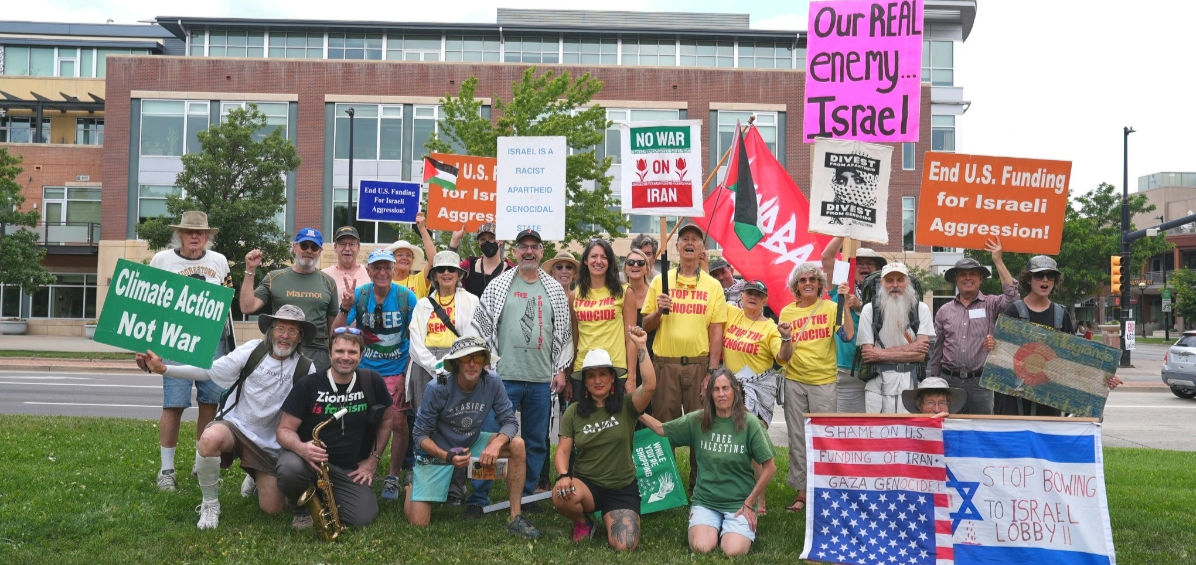
We are Boulder residents who stand together every Saturday against genocide, apartheid and imperialism — abroad, and on the ground we are standing on. Anyone is welcome. Nothing is asked of you but to be there.
No sign-up, no membership, nothing to bring. Come stand with us.
How you can help right now
Not everyone can stand on a corner. These all matter.
Be there on Saturday
The whole ask, in one line. You do not need to know anyone, bring anything, or say anything. Numbers are the point.
Bring your group
We are asking organizations across Boulder and Denver to stand with us on a Saturday morning, not just individuals. If you are part of one, bring it.
Help hold a banner
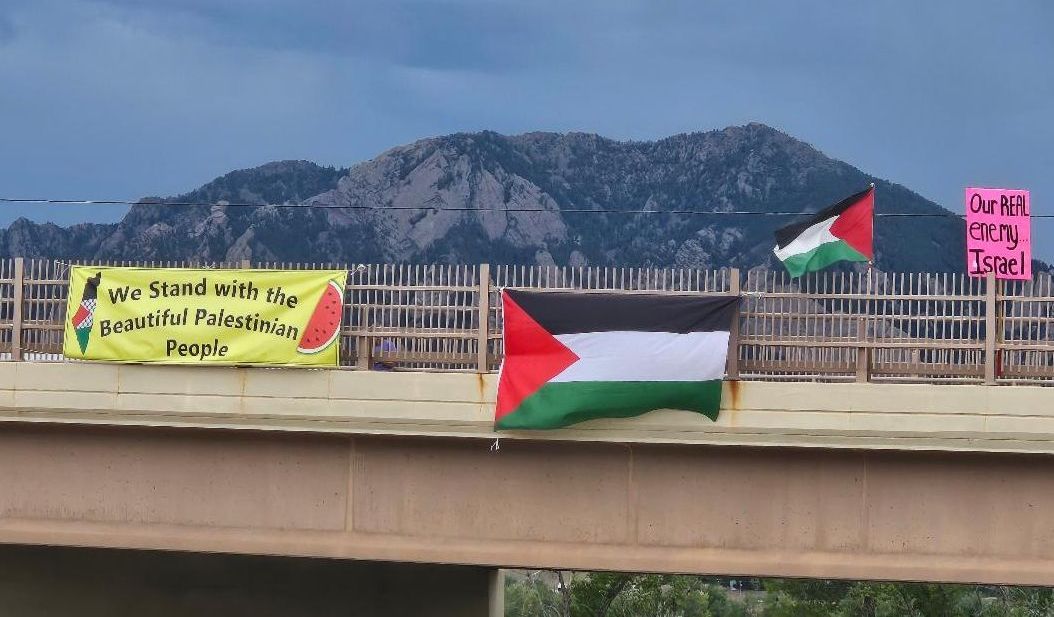
We can no longer rest signs on stands or hang them from trees, so every banner now needs a pair of hands. This is a real job and an easy one.
Come as a witness
Stand back from the line and pay attention. Witnesses who are simply present change how these incidents unfold — and what can be shown afterwards.
Stop funding it
Our boycott list names who is complicit, what they did, and the date they did it. Every entry comes off when the conduct stops. Spending is a choice you make every week.
Pass it on
Send this page to someone who would stand with us but does not know we are here. Forwarding it is the ask Beth made of everyone.
Who we are
We are a group of citizens who live, work and recreate in Boulder. We are opposed to genocide, apartheid and imperialism — wherever they happen, and whoever is carrying them out.
Genocide is not a word we use loosely. Below is what we mean, and who made the finding in each case. Follow the links and read them yourself.
The United States — starting with Boulder
- We stand on land taken from people who are still here. The City of Boulder's own land acknowledgment names nine Indigenous Nations whose ancestral homelands and unceded territory this is. Among them the Núuchiu — the Ute, who lived in and stewarded the Boulder Valley since time immemorial, alongside the Hinono'eiteen (Arapaho) and Tsétsėhéstȧhese (Cheyenne).
- The same document records what this town did. Company D of the Third Colorado Cavalry — "which included 46 Boulder men and prominent Boulder County residents", among them founders of the Boulder Town Company — took part in the massacre of peaceful Cheyenne and Arapaho at Sand Creek on 29 November 1864.
- The Department of the Interior's Federal Indian Boarding School Initiative documented a federal policy built to erase Native cultures and assimilate Native children — Volume I in May 2022, Volume II in July 2024, recording student deaths and burial sites. A formal presidential apology followed in October 2024.
- The treaties were never honored, and still are not. In United States v. Sioux Nation of Indians (1980) the Supreme Court held that the 1877 taking of the Black Hills — land set aside by the Fort Laramie Treaty of 1868 — required just compensation. The Sioux Nation has never accepted the money. The claim is to the land, and it is still outstanding.
Palestine — Gaza
- In September 2025 the UN Independent International Commission of Inquiry found Israel responsible for genocide in Gaza, concluding that four of the five genocidal acts defined by the 1948 Genocide Convention had been committed.
- The International Court of Justice has ordered provisional measures three times — 26 January, 28 March and 24 May 2024 — in South Africa v. Israel, which remains before the Court.
- Amnesty International and Human Rights Watch have each reached the same conclusion.
Sudan — Darfur
- In January 2025 the United States Department of State determined that the Rapid Support Forces have committed genocide in Sudan, against the Masalit and other communities in Darfur.
Myanmar — the Rohingya
- The Gambia v. Myanmar is before the International Court of Justice under the Genocide Convention, with eleven states intervening. Hearings on the merits concluded in January 2026 and the Court is deliberating.
These are not the only ones. They are the ones where an international court or a formal inquiry has already made the finding, so there is nothing to take on our word.
What we are asking for
We are asking local, state and federal government to do two things.
- End all support for the entities responsible for genocide. Every contract, every investment, every shipment, every grant — wherever public money or public authority is currently helping.
- Act meaningfully on the victims' right of return and on restorative justice. Ending support is the floor, not the remedy. What was taken has to be returned, and what was destroyed has to be repaired.
That applies to every situation named above, including the one at home.
In Boulder, the immediate ask is that the city divest from Microsoft.
If it's your first time
You can stand with us without having met any of us. There is no sign-up sheet, no membership, and nothing you need to bring or say.
What the hour looks like
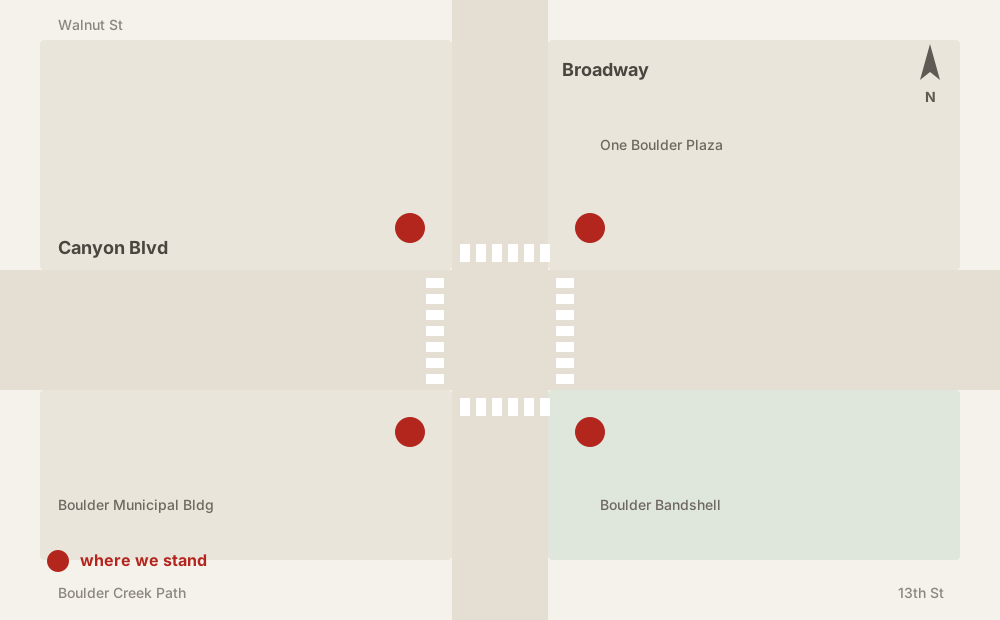
People stand on the corners with signs and banners, facing the traffic. Some talk to each other, some don't. Drivers honk. That is most of it. Nobody is going to put you on a microphone or ask you to speak.
A job you can do straight away
We can no longer rest signs on stands or hang them from trees, so every banner now needs a pair of hands. If you want something to do in your first ten minutes, that is it — ask someone holding one.
If someone comes at you
People have been harassed, shoved and had things taken at this corner. You are never expected to engage with anyone who approaches you, argue back, or hold your ground. Step away and stand with other people. There is no version of this where walking away is the wrong call, and knowing your rights beforehand is worth ten minutes.
Know your rights
What follows is a summary, in our words, of the ACLU's Protesters' Rights guide (last updated 8 June 2026), pulled out to the points that bear on standing at Canyon & Broadway. It is a starting point, not legal advice, and the ACLU's page is the version that stays current.
Where you can stand
- Your rights are strongest in traditional public forums — streets, sidewalks and parks.
- You can generally speak out on other public property too, so long as you are not blocking access to a building or interfering with what the space is for.
- On private property, the owner sets the rules.
- No permit is needed to march on streets or sidewalks as long as you do not obstruct traffic. Police can ask you to move aside to let others pass.
Counter-protesters
- They have free speech rights too.
- Police must treat both groups equally. They are allowed to keep antagonistic groups apart, but should still let each remain within sight and sound of the other.
Recording
- When you are lawfully in a public space you may photograph anything in plain view, including the police.
- Police need a warrant to look through your phone or take it, and may never delete your photos or video, under any circumstances.
- Audio is treated differently from images in some states' wiretapping laws.
If an officer stops you
- Stay calm, keep your hands visible, and do not resist — even if you believe the officer is in the wrong.
- Ask whether you are free to leave. If yes, walk away calmly.
- If you are arrested you can ask why. Then say you wish to remain silent and ask for a lawyer. Do not say or sign anything without one.
- You never have to consent to a search.
If police order the protest to disperse
- That is meant to be a last resort, available only where there is a clear and present danger to public safety.
- You must get clear notice: how long you have, what happens if you stay, and an unobstructed route out — before anyone can be arrested for not dispersing.
If something happens to you
- Write down everything you remember as soon as you can, including officers' badge and patrol car numbers and which agency they are from.
- Get contact details for witnesses.
- Photograph any injuries.
- You can then file a written complaint with the agency's internal affairs division or its civilian complaint board.
Where to go for help
- ACLU — Protesters' Rights, the full guide this summary comes from.
- ACLU of Colorado.
- National Lawyers Guild — Mass Defense Program.